Stories for the before and after
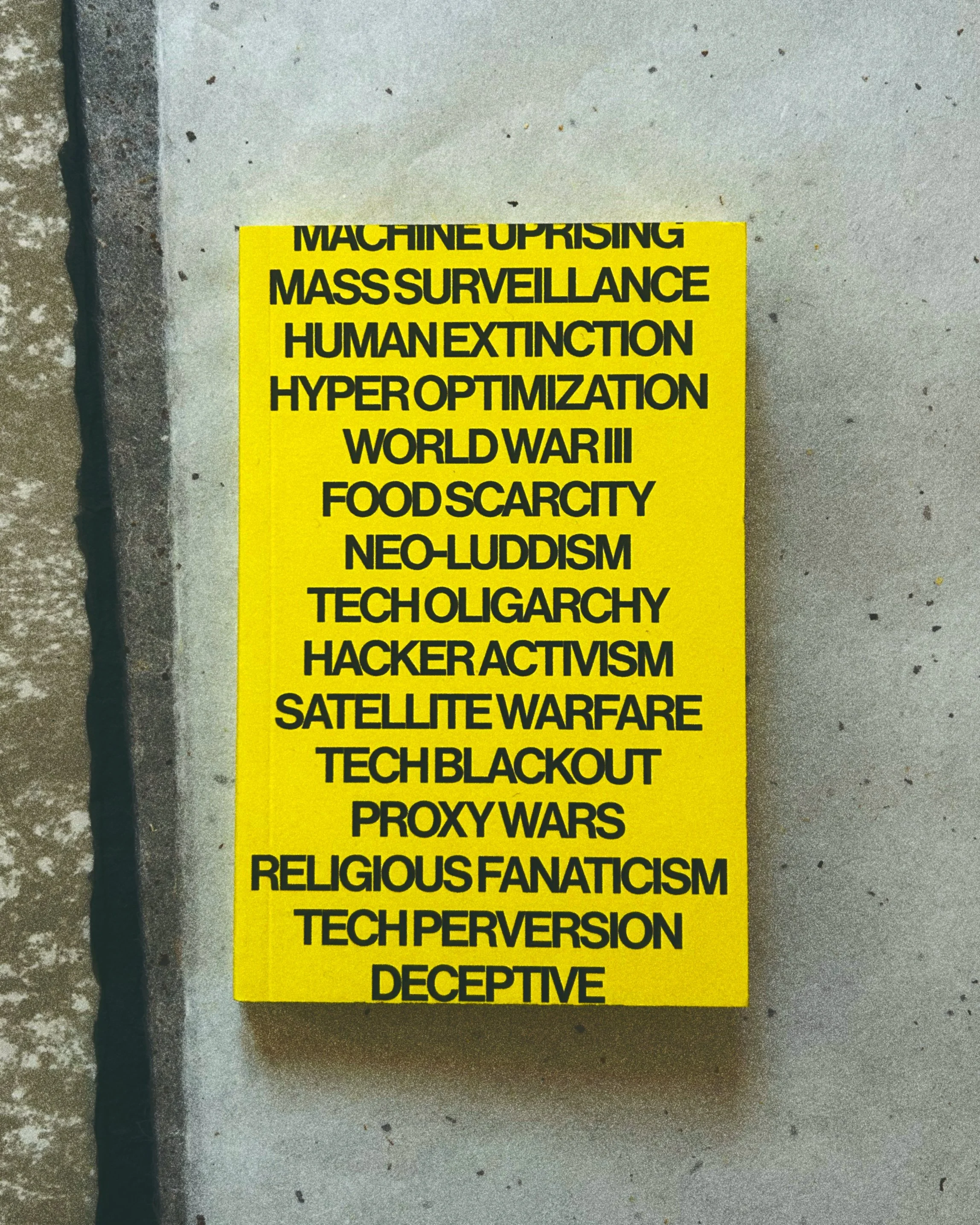
The Elephant in the Waiting Room is a collection of ten science-fiction stories about hope, tragedy, and rebirth in a world that appears to be nearing its end. Authors from diverse backgrounds and nationalities imagine a series of prologues and epilogues for our many uncertain futures. These stories confront our shared fears of a technological future rushing towards us at the speed of light: the grand piano suspended above our heads. We sit in the waiting room, waiting for war, for uprising, for collapse. Who are we without the waiting that defines us?
short story by marjolein pijnappels
mokosh’ knitwork
An abandoned daughter who owns the hidden key to a future of democratised technology is contacted by a figure from her mother’s past. The story unravels as a Ukrainian doctor counts down the seconds to his final surgery. This is the story of a knitting club resisting rogue states with a secret language of stitches.
Rooted in historical developments—like cyberfeminists and Morse code hidden in sweaters during World War II—this narrative challenges us to think creatively about the technological systems and computer networks of the near future.
Excerpt
“They say that during the Satellite War, a new kind of network emerged, woven with wool and code, led by women. In my family, they claim my mother was one of them, a key figure in what insiders call Mokosh' Knitwork. I find that hard to believe. My mother, that inconspicuous and timid woman... a Knitter?”
(..)
Hacking has never appealed to me, so if my mother was a hacker, she didn't pass on the genetic coding for it to me. It's quite something that I even have a laptop. I like plants more than machines. I'm responsible for the food forest in our city park, along with three food forest managers. Together with another fifty volunteers, we provide the basic food supply in the community. I know that the farmers in the countryside eagerly use the remnants of Mokosh' Knitwork to coordinate the local energy supply with the regional grid and heat their greenhouses. But I prefer working with analog and low-tech solutions. Although I am, of course, connected to the decentralized crypto network, I'm not completely outside of society. But I'm a user, not a programmer. And I can't knit either.